In the ever-evolving field of biotechnology, methods for Protein Purification play a crucial role. Advanced techniques enable researchers to isolate proteins effectively, ensuring their functionality for various applications. As buyers around the globe seek optimal solutions, understanding these methods is essential.
Different Protein Purification techniques hold distinct advantages and challenges. Some methods, like affinity chromatography, excel in specificity but may require costly reagents. Others, such as size-exclusion chromatography, are cost-effective yet may sacrifice purity. It’s vital for buyers to evaluate these trade-offs based on their unique needs.
Quality of protein samples can make or break experimental results. Reliable techniques help ensure reproducibility in scientific studies. However, challenges remain in terms of scalability and yield. Reflecting on these aspects may lead to better decision-making in selecting purification methods. With proper knowledge, buyers can make informed choices, maximizing their research outcomes.
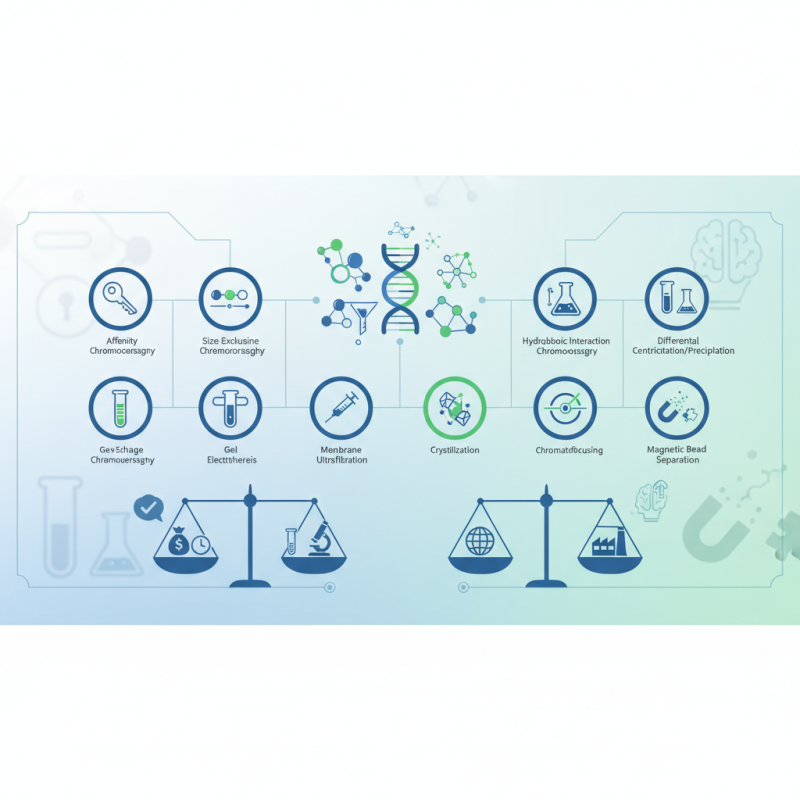
Protein purification is a critical process in biotechnology. It involves isolating specific proteins from complex mixtures, such as cell lysates or tissue extracts. This step is vital for research and applications in medicine, agriculture, and industrial biotechnology. Understanding protein purification techniques can greatly enhance the quality of your experiments and products.
When purifying proteins, consider the technique you choose. Different methods, such as chromatography or electrophoresis, can yield varying results. Not every method is suitable for all proteins. Some proteins may denature or lose activity during purification. This requires careful optimization and troubleshooting.
Tips: Start with a clear goal. Identify your target protein and its characteristics. Analyze your starting material. Don’t overlook small, seemingly negligible details. They can significantly affect outcomes. Regularly evaluate your procedures for potential inefficiencies. Changing one variable can lead to improved results or new insights into your purification process. Experimentation may reveal unconventional solutions. Sometimes, a faulty technique can teach you valuable lessons on protein behavior and stability.
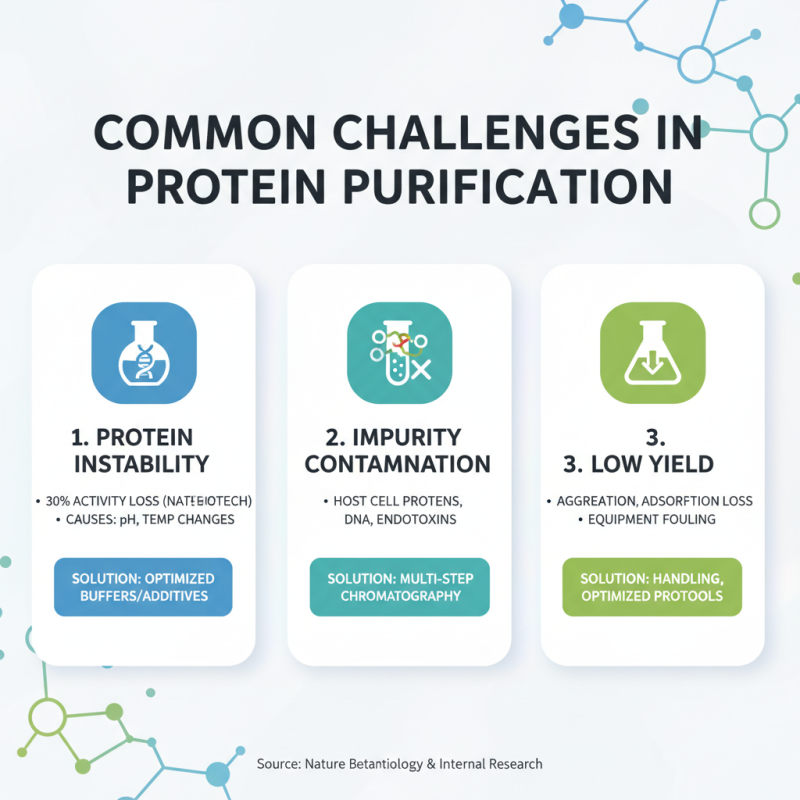
Protein purification is a critical process for various applications in biotechnology and pharmaceuticals. However, it is often riddled with challenges that can impact yield and purity. One common issue is the instability of proteins. According to a report by Nature Biotechnology, approximately 30% of purified proteins lose activity during the purification process. This instability can be attributed to factors such as pH fluctuations and temperature changes. Implementing stabilization measures, such as using appropriate buffers or additives, can mitigate this problem.
Another significant challenge is protein aggregation. Ethanol precipitation and other methods can sometimes cause proteins to form aggregates, hindering successful purification. Studies have shown that more than 40% of researchers encounter this issue, leading to lower yields. Utilizing techniques like size-exclusion chromatography can help separate aggregates from the desired proteins effectively. However, these methods often require optimization, as they may not be universally applicable across different protein types.
Furthermore, contamination is an ever-present concern. A survey by BioProcess International revealed that 60% of purification processes face contamination challenges. This often arises from improper handling or low-quality reagents. Implementing strict protocols and regular training for laboratory personnel can improve reliability. However, even the most diligent laboratories may still experience setbacks, necessitating ongoing evaluation and adjustment of practices.
Chromatography techniques are vital for protein purification. They exploit differences in properties like size, charge, and affinity. This method is versatile and widely used in laboratories globally.
Affinity chromatography is a popular choice. It uses specific interactions, such as enzyme-substrate or antigen-antibody bonding. This allows for high specificity in isolating proteins. However, it may require optimization to ensure the right conditions. The choice of ligand can significantly impact results.
Ion-exchange chromatography separates proteins based on their charge. Cation and anion exchange resins facilitate this process. While effective, this technique can sometimes lead to loss of protein activity due to pH changes. It’s critical to monitor conditions closely to minimize such effects. Each technique has its advantages and challenges, making the choice dependent on the specific protein and desired purity level.
| Technique | Principle | Applications | Advantages | Disadvantages |
|---|---|---|---|---|
| Affinity Chromatography | Utilizes specific interactions between antibody and antigen. | Protein purification, enzyme extraction. | High specificity and yield. | Costly ligands, possible denaturation. |
| Ion Exchange Chromatography | Separates proteins based on charge. | Purification of enzymes, antibodies. | High resolution, adaptable to different proteins. | Requires pH controls, potential loss of proteins. |
| Size Exclusion Chromatography | Separates based on molecular size. | Purification of large biomolecules. | No adsorption, gentle on proteins. | Low resolution compared to other methods. |
| Reverse Phase Chromatography | Uses hydrophobic interactions for separation. | Peptide and protein purification. | High resolution, applicable to small molecules. | Detergents may alter protein structure. |
| Hydroxyapatite Chromatography | Based on calcium phosphate interactions. | Purification of nucleic acids and proteins. | Stable under various conditions. | Limited to certain proteins. |
| Capillary Electrophoresis | Separation based on charge and size. | Analysis of small peptides and nucleic acids. | High efficiency and resolution. | Requires specialized equipment. |
| Density Gradient Ultracentrifugation | Separation based on buoyancy density. | Isolating cellular components. | Method independent of protein interactions. | Time-consuming, requires expensive centrifuges. |
| Precipitation Methods | Based on solubility changes. | Obtaining proteins from complex mixtures. | Simple and cost-effective. | Not very selective. |
| Liquid Chromatography-Mass Spectrometry (LC-MS) | Combines chromatography with mass spectrometry. | Protein identification and quantification. | High sensitivity, multiplexing capability. | Complex data analysis required. |
| Chromatofocusing | pH gradient for isoelectric point separation. | Purification of basic or acidic proteins. | High resolution for complex mixtures. | Requires extensive optimization. |
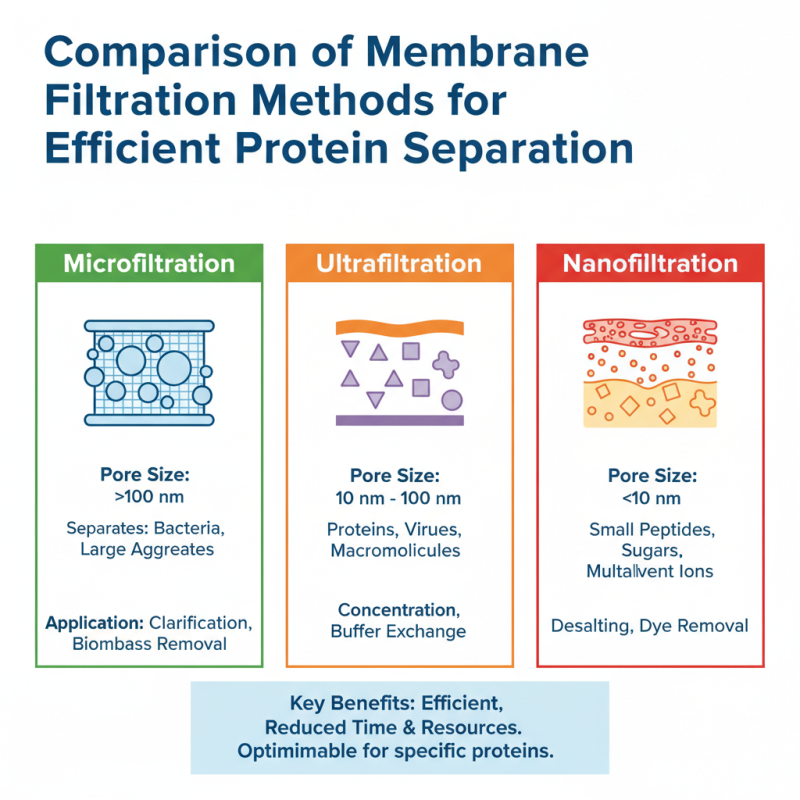
Membrane filtration methods are gaining traction in protein purification. These techniques offer efficient separation processes, reducing time and resource expenditures. Various membrane types and configurations can optimize the purification of proteins. Microfiltration, ultrafiltration, and nanofiltration each cater to different molecular weights and applications.
Microfiltration is excellent for removing larger particles. It effectively captures bacteria and debris. Ultrafiltration can concentrate proteins, allowing for enhanced yield. This method retains molecules based on size, often requiring careful monitoring. Nanofiltration, meanwhile, targets smaller solutes, proving useful in refining solutions.
Despite their advantages, membrane filtration methods have limitations. Membrane fouling can impede flow rates and reduce efficiency. Regular maintenance is vital to sustain performance. Users often face challenges in scaling up these techniques for commercial applications. Moreover, the selection of appropriate membranes can be complex. Adopting the right technology requires extensive knowledge and experience in protein chemistry. Balancing efficiency and cost remains a crucial evaluation point for buyers.
Emerging trends in protein purification technologies are shaping the landscape for global markets. The demand for high-purity proteins continues to grow. This is driven by advancements in healthcare, biotechnology, and food science. Novel techniques are developing rapidly. Researchers are focusing on efficiency and cost-effectiveness.
One significant trend is the integration of automation. Automated systems improve consistency and reduce human error. However, initial investment costs may deter smaller labs. They must weigh long-term benefits against upfront expenses. Additionally, there is a shift toward eco-friendly methods. Green chemistry principles are gaining traction in the purification process.
Another noteworthy trend is the use of nanotechnology. Nanoparticles enhance separation processes and increase yield. While promising, these methods require thorough validation. Understanding their impact on protein structure is crucial. As these technologies advance, ongoing evaluation and optimization will be necessary. Challenges remain, and adaptability will be key to success in this evolving field.
This chart illustrates the popularity index of various protein purification techniques among global buyers. Techniques such as Affinity Chromatography and Ion Exchange Chromatography are leading choices, while methods like HSCCC and FPLC are gaining traction. The popularity index, rated from 1 to 10, provides insights into market trends and emerging techniques.